Do you tend to fall in love with people who are emotionally unavailable? Are you terrified that your partner will abandon you at the slightest disagreement? Or, on the contrary, when someone gets too close, do you feel suffocated and need to run away?
We often believe we have “bad luck” in love or that we are simply “like this.” But at PsicoDiversa Málaga, we know that the way you form relationships today is rarely random. In most cases, these painful and repetitive patterns are the echo of childhood wounds and unresolved early trauma.
To change your present, it is sometimes necessary to understand how you learned to love in the past.
The map of love: Attachment Theory
Our early years are like a blank canvas. The relationship we have with our primary caregivers (parents, grandparents) is the “first draft” of what love and safety mean to us.
If those early figures provided unconditional love, comfort, and protection, we develop secure attachment. We learn that the world is a reliable place and that we deserve to be loved.
But what happens when that environment fails? If there was abandonment (physical or emotional), rejection, constant criticism, unpredictability, or abuse, our child brain creates survival strategies. These strategies become our attachment wounds.
3 ways childhood trauma affects your relationships today
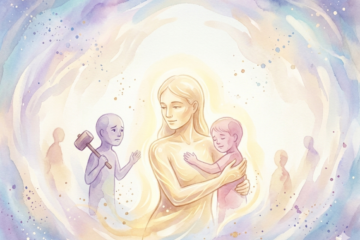
That wounded child does not disappear; it continues living inside you (what in IFS Therapy we call “exiled parts”) and takes control when you fall in love. Here is how it manifests:
1. Fear of abandonment (Anxious attachment)
If as a child you felt love was inconsistent (sometimes attention, sometimes neglect), as an adult you may develop strong emotional dependency.
- The symptom: You live in a state of alert. You analyze every message and tone of voice from your partner looking for signs they will leave you. You cling, over-please, and suppress your own needs to “ensure” the other person stays.
2. Fear of intimacy (Avoidant attachment)
If expressing emotions in childhood led to rejection, punishment, or feeling like “a burden,” you learned to disconnect.
- The symptom: You are highly independent. When a relationship becomes emotionally close or requires commitment, you feel overwhelmed. You build walls, distance yourself, or look for flaws in your partner to justify leaving before they can hurt you.
3. Attraction to the familiar (Traumatic bonding)
This is the most complex wound. The human brain seeks what is familiar, even if what is familiar is painful. If you grew up in a chaotic environment, with yelling or emotional coldness, a stable and healthy relationship may feel “boring” or unfamiliar.
- The symptom: You feel magnetically drawn to narcissistic, unstable, or emotionally harmful people, repeating the cycle of abuse you experienced (or witnessed) in childhood.
You are not “broken”, you are surviving
It is essential to understand this: your toxic relational patterns are not a personality flaw. They are brilliant survival strategies your brain created when you were a child to protect you from pain.
The problem is that today, as an adult, the same armor that saved you yesterday is preventing you from embracing the person you love today.
Healing at the root at PsicoDiversa Málaga
Understanding where the problem comes from is the first step, but intellectual awareness alone is not enough to change it. Attachment wounds are stored at a very deep level in the nervous system.
That is why, at our psychology center in Málaga, we do not limit ourselves to “giving relationship advice.” We work with depth-oriented therapies specifically designed to reprocess trauma:
- EMDR Therapy: To desensitize painful memories from the past that are still being triggered today.
- IFS Therapy (Internal Family Systems): To embrace your wounded “inner child” so your adult “Self” can take the lead in your relationships.
You do not have to resign yourself to repeating the same story of pain over and over again.
Request an assessment and begin healing your attachment wounds with us.
0 Comments